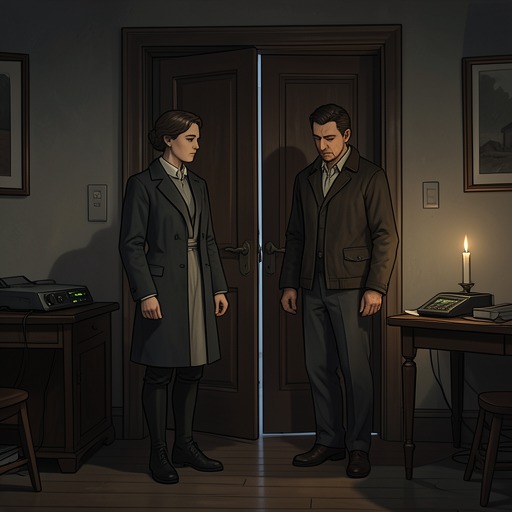
Pietrek’s attempted assault on Jagna
The PeasantsPietrek’s attempted assault on Jagna exposes how her sorrow and exhaustion leave her momentarily passive, but not without agency: when his advances become unmistakably forceful, she throws him off and threatens to defend herself.
Encounter and Resistance
After returning ahead of the others, Jagna had plunged into work, taking on chores throughout the household while tears continued to stream down her face. Pietrek stayed close, helped with the work, and watched her intently. In the barn, as Jagna filled a basket with chopped straw, he seized her by the waist, pushed her against the haymow, and reached for her lips. She did not resist at first, seemingly swept along by the encounter; when he threw her onto the straw and pressed his lips to her face, however, she sprang up, hurled him onto the threshing floor, and angrily warned him never to touch her again. She picked up a rake, then broke off, finished her chores, and went back to the cottage.
Aftermath and Shared Grief
The encounter does not end in reconciliation or explanation. Jagna returns to the cottage and meets Hanka at the threshold; their tear-glazed eyes meet, both heavy with pain, and they hurry apart. The brief exchange places Jagna’s distress within the household’s wider grief without resolving the distance between the two women. Her attempt to bury sorrow in work has not quieted it, and the scene closes on separation rather than comfort.
Language and the Limits of the Scene
Jagna’s response turns the barn’s work materials into the terms of a physical reversal: she throws Pietrek from her “like a truss of hay,” making the object of her labor the measure of his sudden loss of control. Her fury then becomes explicit in a string of insults and a threat to break his legs if he touches her again. Calling him a swineherd and mocking his skill at courting, she refuses the intimacy he has tried to impose and names the encounter as an assault rather than courtship.
Yet the scene offers no extended confrontation or resolution. Jagna abruptly stops, finishes the chores, and returns to the cottage. The narrative leaves her distress and the household’s grief in view, but does not say what Pietrek does afterward or show any reckoning for his conduct; the force of her resistance is clear, while its consequences remain outside the scene.
The Ambiguity of Consent and Refusal
The encounter’s shift from Jagna’s initial passivity to her fierce resistance makes the boundary between being swept along and consenting impossible to treat as settled by her silence: the narration first presents her as failing to register where Pietrek’s advances are leading, then marks a decisive break when he throws her onto the straw. Her reaction is immediate and physical before it becomes verbal, and the scene does not supply an explanation that would reduce this change to a single motive. Instead, it preserves the force of the turn itself: whatever her earlier stillness means, it does not authorize Pietrek to continue.